Tuesday, February 28, 2023

A Cambodian Christian's Buddhist funeral

The last time I saw Pu ("Uncle") Deum...

there was a joyful reunion. We both surprised each other: I had told him that our mutual friends the Arters would be visiting with their team from Phnom Penh in late January, but I wasn't sure which day we could visit his village, nearly half an hour from Preah Vihear town. Once they arrived and made a plan, I tried to call but couldn't reach him, so we just drove out to look for him, hoping he wasn't away on his farm. We were all delighted when Pu and two of his daughters were home with time to eat lunch and hang out. Sometimes, Cambodians' flexible approach to time is awfully convenient!

Pu with the older Arter boy during the 2020 homestay

It was the Arters' first visit since spending two weeks with Pu's family to learn Khmer, and Pu had never met their second son. He enjoyed reminiscing with them about their older son, who joined our final English class at Pu's house with Pu's grandsons and some neighbor kids. We gathered to pray with Pu for his wife, who had gone to Phnom Penh the previous morning to resume chemo treatments after surgery to remove a tumor last year.

The reunion, January 24, 2023

Lunch included my interns, the Arters' teammates, and Pu's grandsons

The first time I saw Pu Deum...

was in 2018, when a very drunk, friendly man kept interrupting the Sunday School class at Pu's house. Why don't the hosts ask him to leave? I wondered. Then I found out that this man WAS the host. 

Pu Deum's daughter Sinat, one of our high school students at the Plas Prai dorm in 2018, gave me permission to share her family's story in this post. She was accepted to the dorm partly because her father's alcoholism had crippled his ability to work and exacerbated the family's poverty. Pu's life was never easy, between growing up in the 1970s during a genocide, dodging nearby guerilla warfare for twenty years, losing an eye in an accident involving machinery, and subsistence rice farming. At least one of his siblings and several neighbors likewise turned to alcohol for solace, finding it a cruel mistress. 

While at Plas Prai, Sinat trusted in Christ and told her parents about him. Pu remembered seeing the Jesus film as a teenager and sensing that it answered his big questions about life, but not yet knowing any local Christians with whom to discuss its significance. Now, his daughter's words resonated deeply, and he and his wife Ming ("Aunt") Nia decided to follow Sinat and become Christians. They began studying the Bible weekly with my teammates Jim and Carolyn. 

Pu and Ming's baptism in March 2021, with their son and 2 of our dorm partners

Pu's alcoholism still distressed his family, who encouraged him to go stay with a pastor in another province who helps people detox. Pu was afraid, and twice he ran away after agreeing to go. Then he had a dream about Jesus. "Jesus is real," he often told people after that. "The moment I saw him, all my fear was gone." He lived with the pastor for several months and was mostly sober after that,  except for a relapse during Ming's surgery last year. In debt and without health insurance, Pu found the extra medical expenses very stressful. With his wife five hours away, Pu succumbed to temptation, but stopped again after another brief stay at the pastor's house.

Ming and Pu studying the Bible in May 2022

Pu helping the World Team interns recruit English students, November 2022

Pu, Ming, Jim, Carolyn, and Sunday School volunteers meeting at Pu's home in January 2023

The day after I last saw Pu Deum...

Pu started drinking again. He'd voted last year against his wife getting the recommended chemo after surgery, feeling it was too expensive and unnecessary. But his daughter Sinat realized the chemo's importance and had recently promised to share the cost... a cost which still paralyzed Pu with anxiety. For ten days, Pu was so drunk that when Ming came home, she couldn't even tell him the tragic news that her cancer was back and had spread. Jim and Carolyn went to visit them and found Pu with a mostly-empty bottle of strong palm liquor, 25 cents a liter. Jim had to pull him out of the busy road in front of the house because Pu was too drunk to notice the oncoming vehicles. The evening of February 3, he was killed instantly in a hit-and-run.

All my teammates and the Plas Prai staff piled in the car that night to see his family. Pu's body lay draped in a sheet upstairs while half his village milled around, including his still-intoxicated buddies. Overcome with grief and shock, Ming initially said she wanted a Christian funeral for her husband, but his mom and siblings quickly took over. There would be a Buddhist/animist funeral the next day, hours after Pu's two middle children returned on the night bus from Phnom Penh. (Some of the rites I'll describe here are Buddhist; some are animist or a mix; there's a lot of variation in Cambodian practices.) 

I doubt the relatives intended any malice. Since Pu's family are the first Christians in their village, nobody there had any idea about Christian funerals. And given his sudden, violent death and Cambodians' fear of confused, agitated ghosts, I'm sure his relatives were extra concerned that his body be swiftly and properly laid to rest in a familiar way. My teammates said it might be wiser to yield. They remember someone dying years ago who was the sole Christian in his family and village, and his Christian friends' stubbornness about having a Christian funeral added to the family's grief and left a bad impression on the community. We believe Pu's funeral type has no impact on his destiny, so we could afford to be gracious. The Christians planned a small gathering to follow the Buddhist rites.

This funeral felt more intense than others I've attended. Usually, I've just been invited to the meal at a tent outside the family's home, after the rites. In the background I can hear monks chanting instead of pop songs, and the color scheme is different, and there's no dancing, but otherwise it's a lot like attending a wedding. People sit around eating and making small talk. 

But here, the grief was raw. Funerals are usually 3, 7, and/or 100 days after a death - not within a day. And obviously, Pu's death was unexpected. Ming couldn't participate in the rites happening in their front yard; she could barely stand up from weeping. Her children wept, too, on display for hours in traditional white clothes. Her son, a recent dorm graduate, felt uneasy as a Christian participating in the Buddhist ceremonies. We encouraged him with what he already knew: he had no say in the matter and was just being a dutiful child. "I have to stand there while the monks chant," he told us, "but in my heart I'm praying to Jesus." 

I missed the morning ceremony, known as howoo praleung, or "calling the soul," something I've only ever read about. Procedures and purposes vary. In this case, the achar (Buddhist master of ceremonies) tied a red string to a stick and took it to the spot down the road where Pu's body was found. He set out food for Pu's spirit and gradually pulled the red string farther and farther back toward Pu's house to bring him home. 


We arrived just in time for a procession by the achar and Pu's children with Pu's casket, from the sleeping area upstairs in Pu's home, down the stairs, out to the front yard, three times around the funeral pyre's middle level, and up to the top. The journey up the tall tower symbolizes their wish for Pu to reach heaven. This is a more expensive means of cremation; it's normally done at the pagoda's permanent facilities. Was the money recently borrowed for Ming's chemo all burning up in Pu's cremation? I later found out that it was, but the family was anticipating an eventual funeral payment of the same sum since Pu was an army veteran. It makes me sad that many Cambodians believe their loved ones' security in the afterlife depends on how much they can afford for the funeral.


The Christians and the dorm students prayed with Ming and the children and then mingled with the other guests during hours of monks chanting and funeral music amplified by massive speakers. At Buddhist events here, the crowd is not expected to pay attention - what counts is just showing up. I met some parents of our students from English and Sunday School. Many neighbors had seen the four foreign World Teamers at Pu's house over the years. Several neighbors told me, "Pu was a good man. Even if he sometimes drank too much, he never hit anybody." Pu and Ming had always said the same thing. 


The monks lowered Pu's casket so cremation could begin at 7 PM, the hour of Pu's death the night before. It started off with a literal bang as the achar and his helpers lit fireworks for several minutes that made the audience shriek, just meters away. All the local guests stood attentive during the fireworks, their hands clasped in a gesture of prayer. I'm not sure what's causing the loud moans in the video... the fireworks?... but they were seriously creepy. Combined with my fatigue, the bright flashing lights, the traditional music blasting from a smartphone's YouTube playlist, and the chanting, my American self experienced major sensory overload. 


I felt for Pu's children, who had to sit rigidly facing the pyre for hours, keeping vigil at the cremation. Normally in this part, the neighbors, friends, and relatives also stay on site until the cremation is finished; they keep busy by eating, drinking, and gambling.  Every now and then, the cremation was paused while bone fragments were removed for other ceremonies - some of Pu's bones ended up in a local river, and others in a spirit house in his yard. The Christian/dorm student contingent did some clean-up from dinner and headed home soon after the cremation started, so I can't verify people's behavior later on, but they were still orderly when I left at 8:30. 

Several dorm students asked me how Christian funerals differ. "Burial is more traditional," I told them, "but cremation is okay too. Either way, our bodies can be raised again. We sing and read Bible verses about our hope of being resurrected with Christ, but we don't have a lot of set rituals because we believe Christians are already safe with God." 

Was I actually fine with with this funeral, though? From calling the soul to chanting to carrying the casket up the tower, I wasn't sure what was happening in the supernatural realm. In trying to appease Pu's spirit and protect his surviving family, I believe the achar and monks could well have invited demons into the home. Could Ming resist them while mourning her husband, battling cancer, and losing her husband's income? (Since her cancer, Ming has been too weak to farm; she mostly does housework and watches her grandsons.) 

A soft-spoken woman with minimal formal education, Ming has never been much of an independent thinker. When Carolyn asked her, "Where is Pu?" she pointed to the spirit house. Carolyn reminded her, "No, that's just his bones. Pu is in heaven with Jesus." "Yes," Ming replied, "because he was a good person and never hit anyone." "No," Carolyn gently corrected her, "like all of us, he had sins he couldn't escape on his own. But he trusted Jesus to save him through Jesus' death on the cross." "Oh yes, that's right," Ming assented. Ming struggles to retain new concepts and stories, and given the trauma of recent events, it's not surprising that she'd revert to an old idea.

Now that the only other believer in town is her youngest daughter, age 14, I'm not sure how well Ming will withstand her village's criticism and peer pressure. We're praying for her miraculous healing, and dreading how the village might blame the family's conversion to Christianity for the suffering they've experienced. But thankfully she has some support. Last week, she and Carolyn visited her aunt's church. Her two middle children, now being discipled at our colleagues' university dorm in Phnom Penh, have a strong faith they can articulate clearly. We promised her this month that her youngest can live at Plas Prai next year when she starts high school. Under threat of being disowned, Ming allowed Pu's relatives to install the spirit house, which Christians wouldn't normally have. But while Buddhist relatives leave offerings there, she and her Christian children choose not to participate. 


We returned two days later for a small Christian gathering. One happy surprise was discovering that Ming has a Christian aunt in a nearby village. After several songs, we took turns reading Bible verses and encouraging Pu's wife and kids. Finally, Carolyn reminded us of Pu's testimony. "He sought the truth from a young age," she told us, "and he knew when he'd found it."

"The next time we see Pu Deum..." 

she reminded us, "he will have the same giant smile that appeared every time he told his testimony. Pu is healed, happy, and smiling. We don't need to fear his ghost!"


The next week, when we went out to teach Sunday School, we were sad to find no village kids waiting for us. "They're all scared of Pu's ghost," Ming confided, pointing to the golden spirit house. We set out on foot to invite them back and reassure them that Pu couldn't hurt them. I was so thankful for our lesson that day - Jesus' ascension to heaven, where he's preparing a place for us. 

Right near the spirit house, we played Resurrection Tag, where Satan tags people and they have to sit down, symbolizing death. But when Jesus tags them, they come back to life. If Satan tags Jesus, he has to sit down for 3 seconds, symbolizing three days, but then he comes back to life and can keep resurrecting other players. "Pu is resurrected too," we told the kids. "We don't have to fear his ghost because he's safe with Jesus, just like we will be if we trust in Christ." By the end of the lesson, nearly twenty kids had joined in, and in the following weeks they came unprompted. 


My teammates and I certainly wouldn't have chosen to conclude Pu's life on earth in this way. We grieve the fragility of life here. If Cambodia were more like the US, with AA, Medicaid, closer hospitals, and guard rails around limited-access highways, Pu would almost certainly be alive today. We have concerns and questions about the future. Will Ming join her aunt and worship with a nearby congregation? Will her cancer be healed in this lifetime? Will the citizens of Bakam village end up more open or closed to Christ than before? Will some of these kids and their families one day worship God with Ming and her children? Will the Bible study fizzle out and come to nothing? 

We have no control over these questions. But we want to be obedient, and we want to pray in faith that God loves Bakam village more than we could. May the Bakam community see Christ's faithful love and power as we keep walking with this family. And may we hold on to our confidence of a joyful reunion with Pu Deum, where we'll compete with him for the biggest smile.

Friday, January 20, 2023

Redefining easy

“Kids nowadays have it so easy!” How many times have we heard that expression? I, for one, don’t think the Plas Prai dorm students have it nearly as easy as I did at their age. They do many chores, have few possessions and little spending money, live far from home, and struggle to keep up in mediocre high school classes after attending low-performing middle schools. Many of them only got electricity in their homes in the last five or ten years, and it’s still just a couple light bulbs and an outlet to charge phones. Their families have no running water, minimal furniture, a few changes of clothes, and a diet consisting mostly of home-grown rice and hot chilis. But last week I heard from a student’s mom who put the students’ hardship in perspective. 

We took a team from Davisville Church (Muggs, Holly, and Michelle) to visit Muggs and Holly’s sponsored student’s family. Mony, a Plas Prai student who just started grade 12, is the youngest of three sons. We met his parents, his maternal grandma, and his mom’s older sister, as well as a crowd of friendly neighbors. We also went past the homes of at least six other awesome Plas Prai students or graduates from his village - they've sent us quite a crop, including one current dorm staff and one current World Team intern! 

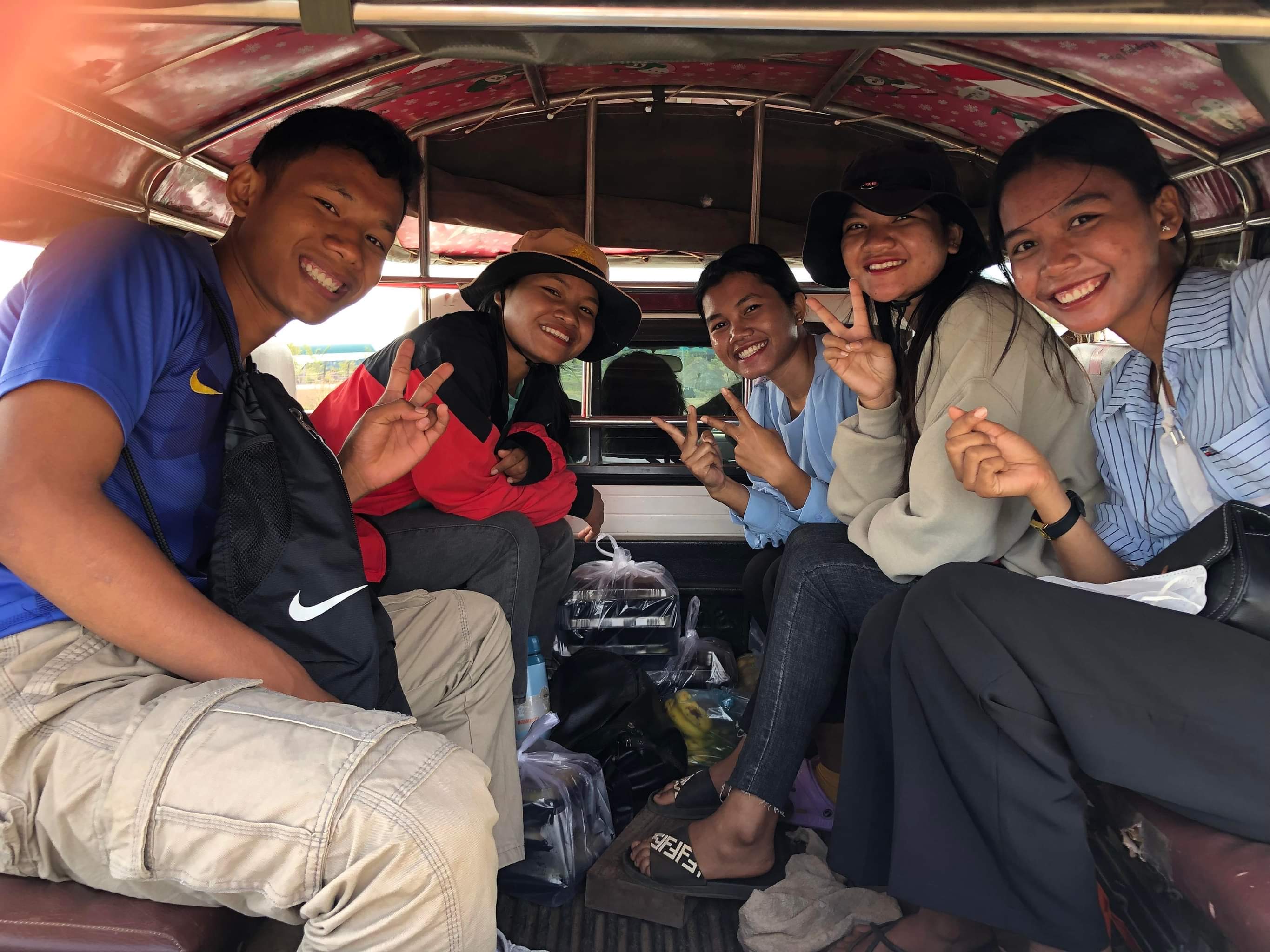
L to R: Mony, a dorm staff member, and the 3 World Team interns in the back of the truck, ready to visit Mony’s family. Visakha (center) is from the same village. 

A warm, kind hostess, Mony’s mom told us a bit of her story.

“When I was three, my father died under the brutal Khmer Rouge regime of the late 1970’s [along with about ¼ of the Cambodian population]. I was the youngest of eight children, and they had everyone on near-starvation rations, so I didn’t really start eating solid food until I was five. The Khmer Rouge assigned everyone forced labor, even children. Starting at age three, I was sent daily to pick beans and sort rice with other children. At night, I came home to my malnourished mother and she breast-fed me and gave me whatever scraps of rice she’d been able to scavenge.  

"When the Khmer Rouge regime was defeated in 1979, we kids didn’t have to work anymore, and our families wanted us to be educated. But all the teachers had been executed and we didn’t have a school building. So anyone in the village who had studied a little bit came and taught the kids under a big tree. At night, they told us to go home and teach what we had learned to our older siblings and parents, most of whom had had minimal or no formal education. Eventually a teacher came to our village, and I finished grade four at age 16. Back then, a grade 4 education was enough to go work in the nearest town, but my teacher encouraged me to ask my mom if I could continue studying. That meant moving to the next province, since our province didn’t have any middle schools. 


"My mom agreed, and she took me on foot on a three-day journey to Steung Treng province, sleeping on the road both nights. I received a government scholarship with room and board to study through grade seven in their province capital, since there were no middle schools in our province. I was the only one in our village to study past grade four. After that, I returned to our village and became a teacher for five years. I felt so privileged to have this education, and I was glad to pass on what I’d learned to my neighbors. Khmer Rouge guerrillas were still hiding out in our area, and they came and burned down a bunch of homes in our village. Our community was terrified and fled to another area for about six months. When we came back, we helped each other rebuild, just like always. 

"When I was twenty-five, my parents arranged a marriage between me and a man from our village. He didn’t have as much education but he was a hard worker. We had three sons together, and when the youngest (Mony) was one year old, my husband was run over by an oxcart that crushed his leg, back, and head. There were no motor vehicles back then, and the mud on the road was up to my thighs that time of year, but I pushed him in a cart to the nearest town with a medical clinic. It was terrifying and exhausting! Eventually we got him to Phnom Penh for further recovery. He survived, but his personality changed. He became as simple as a young child, short-tempered, and prone to violence. He used to wander off at night. The kids were afraid of him. To this day, nearly twenty years later, we have to take him to Steung Treng province [now about a 2-hour drive] every month for medications so that he’ll stay calm and close to home. He helps herd the cows [normally a child’s job] but he can’t do much to help with the rice and cassava crops. My 95-year-old mom also lives with me, and she still sweeps the yard every morning. 

Muggs and Holly meeting Mony’s family 

"It hasn’t been easy farming alone and caring for my whole family, but I am willing to sacrifice anything to see my sons be educated. Even though I could really use their help on the farm, I’m happy that they can study further than I did. Their lives are so much easier than mine. One son is in Bangkok, working as a translator now that he has finished studying. The next is six hours from here in Kampong Speu province with a university scholarship. Now Mony is in his last year of high school. I want to give him the freedom to continue studying too.” 

Mony once told me he feels a great burden to return to the farm and help his mom in his brothers’ absence. We’ll see if he does so next year, or if he is able to embrace other opportunities that might open up, such as university. All Plas Prai students are eligible for a scholarship to a six-month “Discipleship Training Program” through YWAM, and Mony is serious about his faith. He could also apply for several university scholarships. So he’ll have to weigh his hunger for knowledge against the urgency of relieving his mom’s load on the farm. But I was so moved by his mom's commitment to education and her village's spirit of helping each other. The Khmer Rouge worked systematically to destroy trust and sow suspicion among neighbors and even family members. I'm so encouraged at the way this village overcame the government's poison with their spirit of perseverance, cooperation, and investing in the next generation. 

Michelle took this photo while Mony’s mom was telling us her story

A few days later, I translated a conversation between Michelle (a member of the short-term team) and Plas Prai students. She described her kids' middle and high school schedule, and one student asked about the US high school drop-out rate. It's 5%. By contrast, Cambodia had a 20.2% high school completion rate in 2016-2017, and I guarantee that rate is lower in our students' home villages, all far from high schools. The students got quiet, and I thought they might feel discouraged or ashamed that Cambodia was so far behind the US. So I told them, "When Mony's mom was your age, there were no middle or high schools in this province. And when Cambodia gained independence from France back in 1954, there was only one high school in the whole country. Think how far you guys have come! Now, there's at least one high school in each of Preah Vihear's eight districts, and even more middle schools. Just imagine, maybe you're the only child in your family to graduate high school, but ALL of your children might have the chance to do so. You can use your education to help the next generation."

Plas Prai students still have it far from easy, especially compared to my idyllic childhood and access to excellent schools. But it's great to celebrate the progress that's been made, and to point it out to the Cambodian youth who are poised to make history. Though Mony's mom and grandma are Buddhist, I believe they have been vehicles of God's blessing to their hurting community. If this generation of youth emulates their service, courage, and perseverance, how different could life be for future generations! May Mony and his peers at the dorm follow in their footsteps to multiply hope and kindness across the nation.

Saturday, December 10, 2022

Sharing community at the 3C conference

It's been a while since I last found time to blog, so I thought I'd share this e-mail that I sent to my fellow World Teamers the other day. I expanded a draft by our global director, previewing one of the keynote addresses, so it's a mix of our ideas. 

I'm on the communications team for our first-ever global conference next summer. We're calling it 3C, which stands for Community, Collaboration, and Celebration. This e-mail focuses on Community. While its immediate inspiration is the conference, I was encouraged by reflecting in general on Christian community, and I hope it encourages you too! 


Have you ever...

... taken your church sledding on an Italian volcano?

... embalmed a body in the Philippines?

... spoken to hundreds of students at the Urbana missions conference?

... let your Cameroonian neighbors eat your dead dog?

... shared the Gospel with a witch doctor in Suriname?

Let's face it, our daily lives look pretty different. Do we really have anything in common?

We do!

Whatever our setting, skills, or personality, we have an incredible bond with each and every person attending the 3C conference.


Our unity won't come from gathering in the same resort, singing the same songs, or even wearing the same snazzy T-shirts. 

Rather, we are comrades in the epic battle of redemptive history, pointing to Christ as the Scriptures do (Luke 24:27). We are "striving together as one for the faith of the Gospel." We have common ground in being united with Christ, being comforted by his love, and sharing in his spirit (Philippians 1:27, 2:1).

The central focus of the 3C conference will be to celebrate Jesus together in community. We will discover His will, His plan for us as a community to reach the unreached in partnership with others.

Our human relationships are marred by entropy and fracturing: from the Fall, to Babel, to COVID lockdowns and worker attrition. Yet all things were created by and through and for Christ, and "in him all things hold together." He is the great Reconciler, "making peace by the blood of his cross" (Colossians 1:16-20). And he calls us - his body - to invite others into that same unity with God.


During the 3C conference, we as a World Team community will return to our core guiding principle: the Gospel. The Gospel is good news for those we serve, as well as good news for us, laboring for the harvest each day. 

And that will be the second talk of our 3C Conference:

Touched by the Gospel: We are united to Christ!

Together we will explore how the Gospel impacts and influences all that we do:

  • in relating to one another as a community, united to Christ;
  • in collaborating with others and God's Spirit;
  • and in daily celebrating God's sufficiency in our fragility and foolishness.

The presenters for the second message will remind us in fresh ways of this foundation. We will see our total dependence on God's grace to do the ministry to which he has called us.

Bearing his presence wherever we go, we are members of a community spreading to the ends of the earth. In Christ, we have enough in common to fill eternity. How powerful it will be to taste that community as we exhort each other to drink deeply of his abounding love!

"God's love is as boundless as God himself." 

Dane Ortlund, Gentle and Lowly

See you next summer!


Sunday, July 31, 2022

Venom: an original song

When I played this song for a songwriters' feedback group including the one and only Sara Groves, a ground rule was "No disclaimers until the end." I'm abiding by that here; you'll find the video, lyrics, and finally a set of explanations.


Venom 

When I moved to the jungle,
I prayed, “Lord, please, no snakes”
Only to discover
Something fiercer lay in wait

I glimpsed it in the mirror
It lurked beneath my phone
It even slithered onto me
When I was all alone

A thousand times bitten, I’m finally shy
Its venom is deadly

Self-pity, it promises relief
Self-pity, if I let it sink its teeth
Self-pity, an insidious attack
Self-pity whispers everything I lack

Without a pause to question
I obeyed it to a tee 
And plunged into its narrative 
Of anguish starring me

Resenting those who care for me
Why can’t they do enough?
And when will they appreciate 
That I’ve endured so much?

A thousand times bitten, I’m finally shy
Its venom is deadly

Self-pity, its poison oozes deep
Self-pity, it lulls my love to sleep
Self-pity warns me to take more than I give
Self-pity, what a wretched way to live

Desperate for antidotes 
I’m struck by rays of sun
Their radiance illuminates
And warms my angry wounds

I gaze at the glory
Which silhouettes a tree
A snake’s suspended from its branch
Hope rises up in me 

A thousand times bitten, I’m finally shy
Its venom is deadly

Self-pity, you don’t get to sink your teeth 
Self-pity, I won’t let you taint my grief
Self-pity, healing blood has been transfused
Self-pity, you’re no match for gratitude

Goodbye, you pitiful fool 

The music

As you might guess, I wrote this song the past few months, following my move to Preah Vihear province. The lyrics mostly came first, partly in Phnom Penh (away from my guitar) during my driver's license saga. Wanting a Khmer flavor, I was inspired by music blasting from my neighbors' yard when I returned to PV, which influenced my hook, chord progressions, and melody in the chorus.

This is my first song in which I combine finger picking and strumming with a plastic pick, and those transitions have taken extra practice. Maybe fitting for a song inspired by transitions.

The lyrics


I was brainstorming song topics, and "please no snakes" was first, while "self-pity" was at the end. Suddenly my brain merged the two.

My lyrics explanations below are detailed. Feel free to skip around to lyrics you're curious about.

Section 1: Naming the problem

"When I moved to the jungle" 

I live in the province capital with 20,000 people, on a paved street across from a hospital, not in the treetops with a pack of tigers. But as my teammate Joel says, "This place was all jungle until recently, and the jungle wants it back." Depending whom I'm talking with, I often say I've moved "to the province" or "to the country," but they don't quite capture life in one of the most jungle-y provinces. The video's first two images display the jungle flavor of the empty lot behind the wall around my house.

"I prayed, Lord, please, no snakes 
Only to discover something fiercer lay in wait" 

Joel has killed five cobras at his house in twenty years here. A guy in our Bible school sees snakes at his house at least monthly. My housemate Carolyn once reached for the light switch in a dark bathroom in our house and touched a snake. *shudder* Before arriving, I knew snakes were common, and I'm thankful to have seen just one dead and one alive anywhere this year. 

But it never occurred to me to be concerned about other venomous creatures like scorpions and centipedes, both of which have appeared in our yard and house. Nothing has harmed me, but the irony makes me laugh, and I look out for a wider range of monsters now.


A scorpion exiting the dining room earlier this year


I came to see these creatures as a metaphor for my struggle with self-pity. Though it's not new to me, it wasn't on my radar as a potential hazard of life here. Single missionaries rarely move to the province, and for years I said I wouldn't be one of them. I wrestled hard with my decision to move to Preah Vihear, and I second-guessed it many times in the months between committing (last July) and arriving (this January). 

I kept asking, "Can I thrive?" Can I thrive when I'm one of two foreign women in a three-hour radius? Can I thrive as a childless single in a culture that defines womanhood narrowly? Can I thrive when I'm surrounded by great material and spiritual needs and my capacity to help is so limited? Can I thrive when my former community in Phnom Penh is now five hours away and experiencing rapid turnover? But I never asked myself, can I thrive when self-pity is breeding in the shadowy corners of my life?

"I glimpsed it in the mirror
It lurked beneath my phone
It even slithered onto me when I was all alone" 

I dove right into life in PV. I love my team, my students, my work here. And I was so eager to get to a point of feeling helpful and connected and established that I overcommitted (also not new for me). Whenever I withdrew from the frenzy, my difficult emotions threatened to overwhelm me. Navel-gazing and social media didn't help.

"A thousand times bitten, I'm finally shy
Its venom is deadly"

I was excited to have Sara Groves, one of my favorite ever singer-songwriters, facilitate the songwriting feedback group that helped me with this song. I used to have three different pre-choruses and no repetition except the word "self-pity." To streamline the song and build cohesion, she highlighted "A thousand times bitten, I'm finally shy" and "Its venom is deadly" as key lines from the three pre-choruses that could be repeated. Now I prefer the song this way.

Self-pity may start off subtly, and I've often confused it with healthier practices like "acknowledging my emotions" or "thinking through challenges." Until recently, I wouldn't have said I had a major problem with self-pity, but looking back I can see how I've fed it for years. 

I'm finally wising up and viewing self-pity as a menace I can reject, not a sympathetic friend or a helpful reflection tool. When I asked, "Can I thrive?", self-pity answered, "No!" I'm realizing it's partially right: self-pity and I can't both thrive. This town ain't big enough for the two of us.

Self-pity, it promises relief
Self-pity, if I let it sink its teeth
Self-pity, an insidious attack
Self-pity whispers everything I lack

I think the attraction of self-pity is its sense of indignance: "I deserve better." Sometimes anger is easier than sadness. Self-pity distorts reality to bring an momentary self-esteem boost, followed by increased distress and confusion. It accelerates my emotions into a swirling vortex that tries to consume my whole view of life. 

Section 2: Understanding the problem


Without a pause to question
I obeyed it to a tee 
And plunged into its narrative 
Of anguish starring me

Resenting those who care for me
Why can’t they do enough?
And when will they appreciate 
That I’ve endured so much?

To illuminate my new diagnosis, I turned to the Internet. Wikipedia says this emotion involves "self-centered sorrow and pity toward the self" related to one's own suffering, and can be "'directed towards others with the goal of attracting attention, empathy, or help.'" 

Nobody recommends self-pity. From Forbes to Psychology Today to Alcoholics Anonymous, sources warn that self-pity can be a "deadly character defect" and "downward spiral," "repel[ling] those who'd like to support you" and "sabotaging... success." 

In his excellent pair of sermons, James Jennings argues that even worse than harming ourselves and our relationships, self-pity attacks God's glory. He quotes John Piper, whose book Future Grace identifies self-pity as pride:
"Boasting is the response of pride to success. Self-pity is the response of pride to suffering. [...] Boasting sounds self-sufficient; self-pity sounds self-sacrificing. But the need arises from a wounded ego, and the desire is not really for others to see them as helpless but as heroes. [...] It is the response of unapplauded pride." 

Self-pity is not mentioned explicitly in the Bible, but we can infer it in various characters like Sarah, Leah, Moses, and John Mark. Jonah wishes he were dead when God forgives his enemies and lets his shade plant wither. Martha complains to Jesus, "Lord, don't you care that my sister has left me to do the work by myself?" The prodigal son's furious older brother sulks outside the welcome-home party. 

Each of these three stories ends with the self-pitying character receiving a valid rebuke from God and an invitation into joy. They leave me to wonder, "How would I respond in their shoes?" These stories are themselves a rebuke to me, an invitation to cringe at the crude charcoal sketch self-pity has drawn of my life, and to see in vibrant color again. 
 

Section 3: Addressing the problem


This was by far the hardest section to write. What is the antivenom for self-pity? 

My quest took me on a weeks-long foray into the depths of my personal experience, biblical references to snakes, obscure corners of the rhyming dictionary, 1950s missions history, and the unfamiliar world of snake milking. I even consulted a medical professional. After all that, I had to condense it down to 79 words, 15 of which were repeated from previous sections. Sometimes I doubted I'd ever finish this song, but the process brought some exciting revelations.

Desperate for antidotes 
I’m struck by rays of sun
Their radiance illuminates
And warms my angry wounds 

One night during a self-pity attack, I went out to lock up the gate and moonlight flooded my vision and my heart. I found myself dancing on the driveway to... what else... "Dancing in the Moonlight," feeling seen and loved and cheered on by God. So for a while, this section said "I'm startled by the stars." But starlight is not as bright as moonlight, and even moonlight can't even illuminate wounds well, let alone warm them. 

I realize that warming my wounds probably wouldn't feel comforting, especially in the Cambodian heat. But if self-pity numbs pain and distorts the truth, I might need warmth and illumination in my wake-up call.  I also liked the sun imagery as a symbol of God. 

I gaze at the glory
Which silhouettes a tree
A snake’s suspended from its branch
Hope rises up in me 

Part of the key to escaping self-pity is to look up and see something bigger than my current situation... something glorious. Sunlight and the sky are literal examples that have helped me. 

My favorite part of this whole process was rediscovering Numbers 21, or the "Snake on a Pole" story. God punishes the Israelites in the wilderness by allowing venomous snakes to bite them. To be healed, they must look up at a bronze snake on a pole, which has no healing power in itself but demonstrates their faith in God. 

I didn't remember what they were being punished for, but it's... drumroll please... self-pity! They've been grumbling against God and Moses: 

But the people grew impatient on the way; they spoke against God and against Moses, and said, “Why have you brought us up out of Egypt to die in the wilderness? There is no bread! There is no water! And we detest this miserable food!” (Numbers 21:4-5)

That's right, folks, even the Bible connects self-pity with venom. The serpent on the pole foreshadows Christ hanging from the cross (also described as a tree), receiving our punishment and bearing our suffering. So "A snake's suspended from its branch" is meant to point to Christ's victory over Satan (who appeared in the garden of Eden as a snake) and over the sin of self-pity (here linked to snakes). 

Just as Moses lifted up the snake in the wilderness, so the Son of Man must be lifted up, so that everyone who believes in him will have eternal life. (John 3:14-15)

Self-pity, you don’t get to sink your teeth  
Self-pity, I won’t let you taint my grief

Multiple sources mentioned that recognizing self-pity can interrupt its vicious cycle. I can reject it without rejecting grief and other difficult emotions. The Psalms, drenched with emotions, cry out to God and focus on Him rather than on self. 

Self-pity is never inevitable. James Jennings' sermons highlight the example of Barbara Youderian. The night she learned in 1956 that her husband had been martyred as a missionary in the jungle of Ecuador, she wrote that she was
"[...] trying to explain the peace I have. I want to be free of self-pity. It is a tool of Satan to rot away a life. I am sure that this is the perfect will of God." 

(quoted in Elisabeth Elliot's Through Gates of Splendor

Of course, the ultimate example is Jesus. The only human in history to be entitled to self-pity, he never gave into it. Jesus wept tears of blood in the garden of Gethsemane, knowing he was innocent and about to endure unparalleled suffering. But he submitted to his Father's will, going to the cross "for the joy set before him." 

Self-pity, healing blood has been transfused

Do you know what antivenom is? I didn't until the marvelous Liz Helm sent me some articles. First you milk creatures like snakes and spiders to extract their venom. Then you inject the venom into a domestic animal, usually a horse or sheep, whose blood produces protective antibodies that can be harvested for human use. 

Does that sound familiar? A lamb who suffered the results of our sin, overcame it, and gave his blood to rescue us? Jesus' blood flows in my veins to guard me against future attacks of self-pity. I love finding these metaphors for salvation built into the operations of biology.
"'He himself bore our sins' in his body on the cross, so that we might die to sins and live for righteousness; 'by his wounds you are healed." (1 Peter 2:24)

Self-pity, you’re no match for gratitude

Nearly every source I found, secular or Christian, agreed that thankfulness is a key solution to self-pity. The two are mutually incompatible. While self-pity says, "I deserve better than I've received," gratitude says, "I've received better than I deserve." My gratitude journal has been a tremendous help to me the past decade plus, and I write in it often. 

Everyone has something to be grateful for, but nobody has more than Christians. As Tim Keller writes: 
The gospel is this: We are more sinful and flawed in ourselves than we ever dared believe, yet at the very same time we are more loved and accepted in Jesus Christ than we ever dared hope.
Believing the gospel makes my challenges pale, my pride melt, and my gratitude overflow. Self-pity can be truly deadly... and I've received undeserved new life and a way of escape.

Goodbye, you pitiful fool 

This was Sara's last contribution, changing "piteous" to "pitiful." It even feels better in my mouth. 

This line brings me the catharsis that self-pity never delivered. And this line, along with the rest of the song, have already helped me ward off or interrupt its venomous visits. 

A thousand bites in, I know which of us is destined to thrive.

Monday, June 20, 2022

How to get a Cambodian driver's license in 66 easy steps

I always swore I never wanted to drive a car in Cambodia. I lasted 11 years... but then I moved to the province. 


My teammates told me that while I didn't have to drive, it would really be helpful: one, to transport myself to distant villages, and two, to transport others without vehicles like our students. They offered the use of their pickup truck on occasion. My little 50CC Honda Today is a great town bike for a single rider, but it isn't built for fast speeds, multiple passengers, long distances, or rutted muddy roads. 

Soon after that, colleagues in Phnom Penh asked if I'd be willing to borrow their car in June and July during their trip to the US, so it wouldn't sit idle that whole time. So I found myself undertaking a process that I'd never particularly looked forward to, and it turned out much more difficult than I'd expected. 

If you're an expat wanting a Cambodian license (not an international license converted from your passport country), don't despair! For me, it was worth it despite all the grief. It is possible to pass the test, and I'd love to share with you what I learned from my experience in hopes of improving yours. You can find my study notes, tips, and illustrations in this 15-page Google doc. (Or you can pay a driving school to pay off the instructors and make sure you'll pass the first time.) But if you're here more for the story than its moral, read on.


How to get a Cambodian driver's license in 66 easy steps

1. Ride a public taxi for 5 hours to Phnom Penh.

2. Take your US driver's license, passport, several ID photos, and $45 in cash to the driver's license center at the mall.

3. Find out you need a residency letter from the regional government. This normally requires a lease with your name on it, which you've never had. You also need to convert your international driver's licence at least one month before it expires in September, but not within 30 days of your visa's expiry date in late July, so basically you have three months to get it done.

4. Ask your former landlady if she'll write a lease for you. In your 4 years living there, you were never listed on a lease; there was just an unofficial agreement. Argue politely that you're still keeping stuff at your old place and visiting monthly, and you were sharing the rent with a friend until recently. She kindly agrees to put you on a 2-year lease.

5. Meet landlady and recruit 2 witnesses to watch you sign the 2-page document she printed out in Khmer. Wonder if this could pose future issues if your friend moves out in less than two years. Hope for the best since there's usually a high demand for this kind of apartment.

6. Call a guy who helps foreigners get residency letters. He says it will take at least 3 business days, which would be fine except that it's Saturday and you need to drive 5 hours back home tomorrow. Can they rush for you? Probably not.

7. Learn from this guy that the landlady's lease will not be official enough to merit a residency letter at the government office. He says you need to pay him for a six-page lease and start over with the landlady... but you don't have time to meet her again before you leave.

8. Return to Preah Vihear wondering if you'll ever get a license. 

9. Ask housemates if their landlord would consider adding you to their lease, which hasn't been updated in ten years, even though leases generally only list one name for the entire rental property. They suggest trying to get a residency letter without a lease, since the Preah Vihear office is sometimes more relaxed than in Phnom Penh.

10. Wait a couple weeks for the office to reopen after Cambodian New Year. 

11. Go to the office and wait a few hours. Notice the enclosed dirt area out front, which your housemate refers to as the "cow impoundment lot" for residents' stray livestock. 

12. Be pleasantly surprised when they give you a residency letter on your word that you are staying with your housemates, whom the employees have known for over a decade. 

13. Ask an employee to reprint the letter four times to correct your name, birth date, passport expiration date, and visa number.

14. Leave the office hours later amazed to have a residency letter in hand, without having shown proof of residency or paid any money.

15. Drive five hours back to Phnom Penh for other commitments. Bring the residency letter and other documents to the driver's license center on a Monday, a few days into your 9-day trip. 

16. Reply "no" when they ask if you've ever had an international driver's license. Receive the startling news that you technically had one for a year long ago when licenses were required even for motor scooters under 125 CC. Since it expired in 2012, a late fee of $0.12 per day has been accumulating, totaling nearly $500. 

17. Argue that you never drove a car during that decade, weren't required to have a license for your motor scooter, and lived outside Cambodia for two years of that period. Admit defeat when the sympathetic employee does not budge.

18. Try to understand the employee's advice in Khmer to avoid the fee by taking the national driver's test, which includes theory and practical sections. Take down the center's phone number and address at the Heavy Truck Training Center, 45 minutes outside town.

19. Find out that your residency letter is still incorrect. The last sentence (which you didn't proofread because it didn't have any blanks to fill in) says the purpose of the letter is to apply for a job, not a driver's license. Realize that few people in Preah Vihear have ever taken the test for a driver's license. Snap a photo of an sample residency letter for the PV office to use as a reference.

20. Call the Heavy Truck Training Center, which tells you that you need to come in person to make an appointment for 3-5 days later.

21. Ask friends in Preah Vihear to go back to the office for you Tuesday, get the residency letter corrected, and send it down on a taxi. Since you brought all your ID photos with you, you need your friends to print more ID photos before they go to the office, since the office has already used the five photos you gave them last time. This would be impossible except that you just got ID photos taken last week and the photo place sent you the file for them for the first time in your life. Count it as a minor miracle when the PV office corrects the letter without you physically being there. 

22. Meet the taxi driver at an unexpected place Wednesday to get the letter. Go straight to the heavy truck training center. Take an eye exam and book the appointment for the following Monday morning (3 days after you'd planned to leave the city). 

23. Wrestle with the unexpected question of whether to take the exam in a standard or automatic transmission car. You learned how to drive a manual back in 2008, and while you got lots of practice that year, you haven't driven one in over a decade. But if you test in an automatic car, your license won't apply to manuals. You've never noticed what's common in Cambodia, so you ask a colleague's advice and go with an automatic.

24. Pay $10 extra when a driver claims your fare without actually picking you up, preventing you from booking another ride home for the next 30 minutes. Argue with the tuk-tuk company for a refund, which they eventually provide, and a credit toward your next trip, which they deny.

25. Learn that the test is very difficult and that you need to study for both the theoretical portion and the driving portion. Your Thursday and Friday are booked solid, so this leaves the weekend, when you thought you could finally rest and have extended time with God.


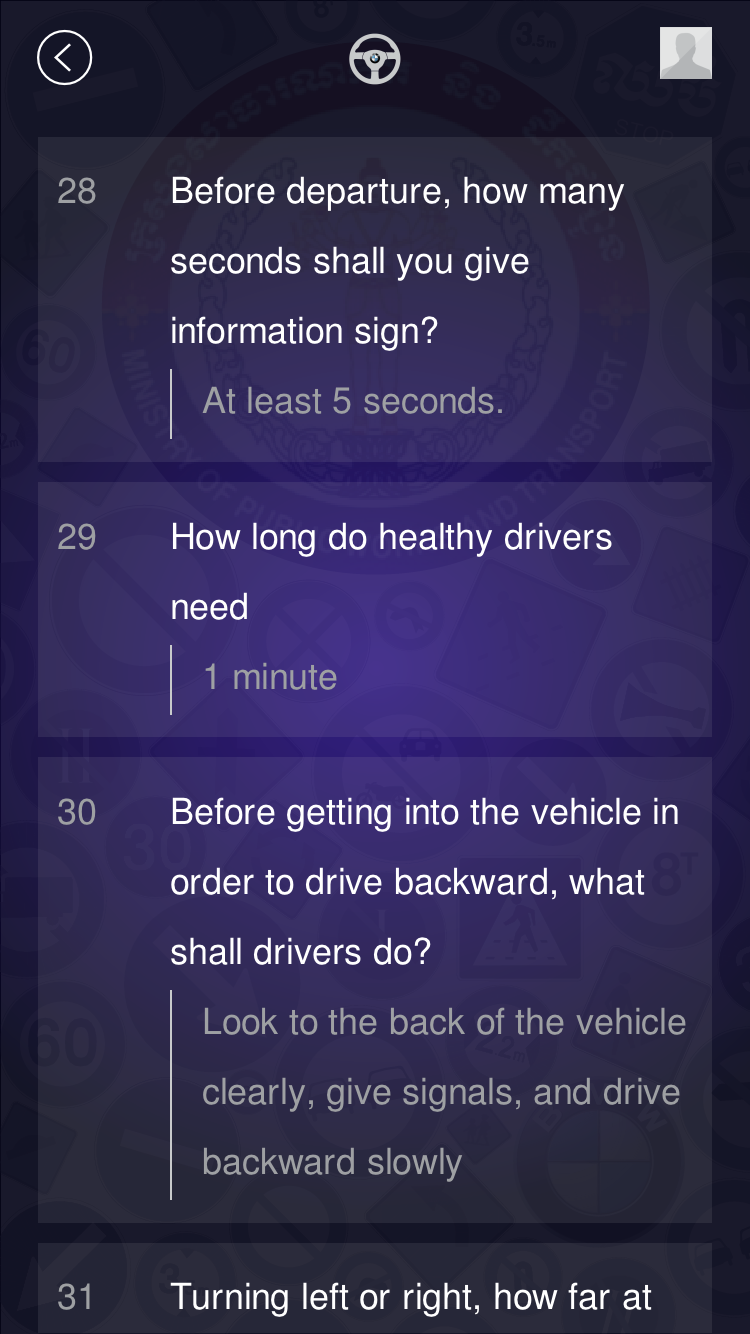
26. Spend about six hours studying theory in English on the app. Quiz yourself repeatedly. You can miss five questions and still pass. You fail about half the practice quizzes, partly because the English doesn't always make sense. Discover last-minute that you've overlooked one section of content. Wake up early to study more.


27. Try the quiz in Khmer to see if it's easier. It's not... unless you want to spend hours learning extra transportation vocab. But one question makes more sense now that you've seen it in Khmer.

28. Show up at 8 AM Monday morning. Pass the theory section at 9 on your first try (yesss!) and learn that you need to take the driver's test right afterward, not in the afternoon like you supposed. Realize you won't have time to rent a car from the center and practice like your colleague recommended. Study the driving course diagram. 


29. Try your best on the driver's test at 10:30. Notice there are almost no Cambodians taking it. Fail when you forget what turn to make (answer: a very sharp one) at an intersection with three options and have to back up to make the turn. 

30. Do the walk of shame, leaving the car mid-course and returning to the building. Exchange sympathetic looks with everyone else who failed. Ask when you can rent a car to practice. Answer: Not today. Only 7-8 AM.

31. Plead with the staff to print your license early if you pass tomorrow. Usually they print it after their lunch break, around 2 or 3, but that would mean you'd have to stay an extra day. Tell them you live 5 hours away and you've already extended your trip four days trying to get this license.

32. Call the taxi driver returning to Preah Vihear. You've really hoped to be on tomorrow's taxi, which leaves at 1 PM, but might go right past the training center 30 minutes later depending which route it takes. The driver agrees to save you a spot but wait until noon tomorrow to hear you confirm if you can ride with him. 

33. Put on your last set of clean clothes and eat the rest of the groceries you bought Saturday, the day after you were supposed to leave town. Go to visit former neighbors, which you naively think will be a brief, relaxing visit. It's anything but. Realize how exhausted you are.


34. Return the next morning at 7 AM with all your stuff from the past twelve days. Practice for an hour ($20), with some help from a compassionate examiner who gives you all the tricks (in rapid Khmer) for fitting a standard 4-door sedan into ridiculously tiny spots for the T-parking (reverse perpendicular parking) and parallel parking portions. These include things like, "When you see pole #2 aligned with the Toyota sticker in your back right mirror, come to a full stop and turn the wheels completely to the left." Wonder if it's advisable in any other context to turn the wheels when the car is fully stopped.

35. Endure his scolding whenever you get anything slightly less than perfect. Try to ask clarifying questions. Be patient when his answers are unhelpful.

36. Get kicked out of the car after exactly an hour, when you are starting to get the hang of his instructions but not yet confident you understand them all, let alone will be able to apply them in a testing situation. 

37. Wait 2.5 hours in the heat again to retake the driver's test. Recognize several faces from the day before, since most test-takers failed their first and/or second attempt. Rack your brain to write down all the tips he gave you. Realize you have a few blanks in your memory

38. Panic at 10:30 when your name isn't on the list they announce. Run into the building where they tell you you should have signed up and paid $15 by 9 AM for the retake. You plead for mercy, pointing out you've been there waiting since 7 AM. They let you register now, but they don't take cash and the payment app isn't working on your phone inside the building.

39. The staff point you to a green building across the street which they say is a Wing, a business where you can send money or pay bills. 

40. The people at the green building tell you it's never been a Wing. They tell you to walk ten minutes down the street. You'd book a tuk-tuk ride, but a) your phone data still isn't working, and b) you know from experience that there's almost no tuk-tuk service this far out of town.

41. Rush back to the testing center, sweaty and sunburnt. They ask in amazement where you've been all this time. "Going to the Wing like you told me." All other test-takers have finished.  

42. Pray as you start the test, "Lord, my time is in Your hands." Acknowledge that you have control over very little in life, and that failing the test again is actually not the end of the world.

43. Fail the test again when you start the T-parking too far to the right. Knowing you're probably going to fail, you try to inch forward and turn enough to get into position, but end up knocking over a cone. 

44. Endure repeated scolding from the examiner, telling you, "You knocked over a cone!" as if you didn't know that was grounds for failing. Finally interrupt him and tell him, "I know, that's why I'm not arguing." Repeat the walk of shame off the driving course.

45. Endure another lecture from the examiner who helped you that morning, saying you didn't follow his instructions. Actually you tried to... he said not to start too far to the left, but in your conscientiousness about that you started off a bit too far to the right.

46. Be mocked by the parking attendants for failing twice in a row. (Not like it's that uncommon!) They tell you to sign up for driver's school this weekend. Tell them, "I can't stay until the weekend. I have to get back to my job 5 hours away." You know your options are to pass within four tries (by Thursday) or else return to PV without a license or a way to transport students to Saturday's baptism.

47. Stand under the noon sun. Have trouble getting a tuk-tuk once again. Finally get a ride with the guard's friend. Find out ants have infested your packed lunch while your bags were sitting in the guard shack all morning. Load all your stuff back into a tuk-tuk. Consider crying. Try to figure out why you are so very bothered about not being back to PV yet.

48. Return to the office where you're staying. Take a long nap. Ask friends to use their washing machine. Buy a few more groceries. Get a much-needed pep talk from a colleague. Spend time with the colleagues who are flying out that night and leaving you their car. 

49.  Return to the testing center at 7 AM. Rent a car for another hour. Feel much more confident.

50. Update your notes. Share them with a woman you recognize who sometimes leads worship at your former church. Chat with her for the first time ever. Try to help her pass on her first try, since she doesn't have much margin to spend here.

52. Celebrate when she passes the theory test. Try to encourage the British guy who just failed the theory test for the third time. Tell him, "I know the answers are ridiculous, but if you practice more with the app, you'll start to memorize them."

53. Take the test for the third time. Everything goes flawlessly until the last section, parallel parking.

54. Back up and angle into the spot at a diagonal. Think you hear the sound of tires hitting the curb. This is not an automatic fail, but you're only allowed to pull forward and correct once, so you have basically no chance of success if that's what you just heard. 

55. Get flustered and forget what step you're on in the stupid nitpicky method you have to use here, which is not like the common-sense intuitive method your dad taught you. Sit frozen for a moment.

56. Listen to the examiner yell through your window in Khmer, "Great, now turn your wheels hard to the left!" Bless him silently and realize your wheels were never near the curb. 

57. Get out and look at your parking job. You needed both your right wheels to be within 25 cm (9.8 inches) of the curb, but you've gotten them more like 5 inches away without a single correction.

58. Stop at the final stop sign and do a victory dance when they tell you you've passed!

59. Call the afternoon taxi driver. He's not driving today so there's no point in rushing home. Decide against trying to drive your colleagues' car from Phnom Penh all the way to Preah Vihear by yourself. Waiting one more day won't kill you.

60. Wait inside the building while the staff prepares your license. Chat with the driving instructor who helped an American guy pass on his first try. Wonder how much kickback she paid for him to pass right away and how much time she's saved him. (He showed up at 10:15, just in time for the driving test, and now she's getting his license for him.)

 61. Get your license from the staff within five minutes. They tell the driving instructor, "This girl lives way up in Preah Vihear. She's lived here for 11 years already!" They don't tell her how you failed twice. 

62. Walk out with a grin. You have a license for the next ten years.


Bonus: I can drive tractors up to 3.5 metric tons.

63. Return to Preah Vihear on Thursday, 15 days after you arrived in the city, six days later than you expected to leave.

64. Load up your teammates' pickup truck with 17 students that Saturday. Drive them 30 minutes away to a waterfall. 


65. Park by the waterfall in a field with no curb, much less a 10-inch distance requirement. Hike in and watch eight students be baptized. The joy is infectious. 

66. Write down everything you learned along the way, in hopes of saving others a few dozen steps.